10:41 AM - Bowie Ibarra
Down The Road may seem to be, at first, a strange name for a zombie horror story, but, as a title, it speaks volumes of the simple genius of Bowie Ibarra’s debut novel. Telling the story of one man, wranglers-clad-all-round-nice-southern-boy, George Zaragosa, and his decision to go ‘down the road’ to visit his family, this isn’t a complex book. In fact, you might well be yawning until I tell you ‘the catch.’
George’s road isn’t like the one outside your window, so to speak. Alas, the road George intends to go down happens to be ram-packed full of post-apocalyptic mayhem, a million zombies and a clearly godforsaken (and everything-else-forsaken) military, who in Ibarra’s post-apocalyptic southland seem every bit as mindless, yet lethal, as the mindless-yet-lethal-zombies.
(And no, I didn’t say the George W or Iraq words… DOH!)
Fairly traditional zombie fodder, you might think… yet to write Down The Road off as simply another for the doomsday pile would be brash, indeed. As John Hubbard, co-author of Wandering Flesh, suggests in the inside cover of Down The Road, this is a book that goes deeper than at first suspected, providing trad zombie fans with something ‘in many ways touching.’ Regardless of Ibarra’s recurring messy sentence structure and economical use of language, Down The Road does what it says on the tin, serving up a highly enjoyable, gore-stained zombie romp that should leave fans hungry for a sequel of two. And it does it all with a heart that is missing from many contemporaries…
Bowie Ibarra is a man who, as Dave Moody comments ‘clearly loves the genre’, and in so doing writes as a fan as well as fan-favourite. All the boxes are ticked, readers encountering endless shoot-outs with zombies and survivors alike, drugged-up ganglords and, of course, the ever-feverish gun-toting rednecks. And through it all, our hero George never loses sight of his simple mission to get down that muther-pumping-gaddam road, bless him, and we never lose sight of George, rooting for him all the way towards the novel’s delightfully plaintive conclusion.
As I caught up with Bowie Ibarra, in cyberspace, I began to suspect the author’s own charm and down-to-earth affability equaled that of George.
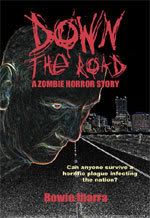
Spiral: In a world where we have talking zombies (Brian Keene’s The Rising), sexy, steamy zombies (Andre Duza’s Dead Bitch Army) it seems interesting to find you trodding a very traditional path with Down The Road. Was there a particular reason for you going back to grass-roots zombies?
Bowie Ibarra: Well, my story is not a reaction against these fantastic works by these authors. On the contrary, when I first started writing it, I naively thought that my book would be one of the only zombie books out there. Boy, was I wrong. In a way, I’m glad I took the traditional approach, as these other books would have been intimidating had I known about them. Not knowing about their trailblazing angles on zombies, I was able to write my yarn without having these stories color and influence my narrative. Don’t get me wrong, they’re fantastic stories, but I knew I wanted something conventional and conservative, yet just as violent and stunning as any zombie story out there.
SP: What makes Down The Road different from other zombie books?
BI: I think what separates my book from the others is my emphasis on the global conspiracy angles I take. Many people are waking up more to the possibility that the U.S. government is not as benevolent or prepared for disaster as some might think. Some, like myself, think that the people who run our government have a hidden hand in many of the disasters and attacks on our nation.
When it comes to government readiness, many readers pointed to FEMA’s response to Katrina as a sterling example of what I was getting at. From the perspective of governmental benevolence, I paint a bleak picture: Disarming the populace and internment for their ultimate safety. Within the internment camps, things are not well, either. Abu Girab is yet another example of how supervised and unsupervised detention of prisoners can turn very ugly very quickly, pointing a jagged finger at the darker side of humanity and those in our military. My dad used to always say that you cram a lot of people into a small space, it’s easy to get edgy. Lets also not forget how protesters were entered into databases at FEMA camps (the old San Point Brig) during the government sponsored Seattle riots and the last New York Republican convention where protesters were housed in an old run down and condemned bus depot.
The old cliché is true: absolute power corrupts absolutely. Look at the news today. At this point it is not official, but the possibility of an actual bill being passed that could have the president identify actual American citizens as “enemy combatants” if they speak or do things considered ‘against’ our country is chilling. Even more scary is that those same people can be held indefinitely in prison, or a ‘camp’, and ‘pressured’ (the new word for ‘torture’) by sodomy or having their child raped or genitals mutilated in front of the parent as long as it is during ‘information gathering’ is outrageous. The fact that we allow it to happen is even more so.
So I write my stories from this perspective. How would the modern police state mentality deal with a zombie outbreak. The sequel goes into that even more. Whether you buy some of the implications in the story as gospel, or think its kooky ramblings of a paranoid nutter, its an interesting and unique angle for the genre, especially in these intolerant and interesting times.
SP: You’ve been described by Travis Adkins (Twilight Of The Dead) as ‘like the Quentin Tarrantino of zombie literature.’ Heavyweight Indie horror gurus, such as Dave Moody (Autumn) and Brian Keene (The Rising/ City OF the Dead) have all heaped praise on you. How does it feel to have that kind of praise from people you, yourself, admire and respect?
BI: I’m very proud of that. It’s an honor to be mentioned by these greats who I do, indeed, admire and respect. They are the ones who are the backbone of the zombie genre, the ones you always see talked about when it comes to zombie literature. So for them to take the time to give me a compliment about my work is an absolute honor.
When Travis brought up the ‘Tarrantino’ similarity in the second edition, I was flattered. Tarrantino really moved people with ‘Pulp Fiction’. Then I think about Quentin being an Aries like me and I thought it was an even more fitting comparison. I watch his movies sometimes and think, ‘man, I know where he’s coming from’.
I write my stories without ‘rules’, in a way. Naturally, I try and write using the proper form and sentence structure. But like Tarrantino, when it comes to the storyline, elements, and perspectives, I try not to limit myself by the typical conventions of the art form or the opinions of the mainstream. I try to express myself as openly and completely as possible, revealing dark aspects and noble virtues that I think we all share as a humanity. Like in acting, the more you are real and truthful, the more people will be moved by it. Whether it’s a feeling of joy, sadness, lust, anger, if you’re making people feel something with your particular artistic medium, then you’re doing right. It feels great.
SP: We’ve seen the Southern states in horror before, namely the Texas Chain Saw Massacre and Deliverance… Apart from living in the region, what made you choose to base Down The Road there?
BI: A wiser man than myself once told me, ‘write what you know’. For example, I love England, but for me to write a story about zombies in London wouldn’t work, as I only have a general understanding of London from Shaun of the Dead, Monty Python, and old Doctor Who shows. I’ve been all around south Texas, and I know it pretty well. So it makes more sense for me to put a zombie outbreak in the republic of Texas.
SP: Down The Road, itself, has endured quite a journey before finding somewhere to call home, in Permuted Press. Tell us about the highs and lows, twists and turns…
BI: It started several years ago. I had just got a real job and a little one room apartment in Austin. Naturally, I had a collection of zombie movies and watched them over the weekends. When I got dial up, I searched the ‘net and found a website called ‘homepageofthedead.com’. I read some of the short stories in there and was impressed. Having dabbled with writing virtually all my life, I decided to give it a go. I threw in “night of the living dead” for mood writing and wrote the first chapter. I didn’t touch it again for several years.
Then a friend commented about a colleague of ours writing and publishing a book in only several months. Granted, that is an exception to the general rule, but it lit a fire under my ass. I decided I was going to hammer out Down the Road and find a publisher.
Within months, I had finished it and started searching out a publisher. Being a little lazy, I found a self-publishing company called Authorhouse that blew sunshine up my butt about how great they were and how great my story was. I found it to be immediately like buying a car, hearing how great they are and how happy authors were. They also had a list of things I could do, though I had to sink a lot of dough into any and all of the endeavors. I opted to take the minimal route, getting it published and out there. I put the promotional efforts in my own hands, as I had already sunk a little over a grand to get it out there. I always had the idea that my book was a kind of book you’d find at a convenience store or grocery store. Small and soft cover. It was pulp style zombie horror, in my opinion. The minimal it needed to get out was fine by me.
Naturally, I went to ‘homepageofthedead’ first. Neil Fawcett, the man who runs the site, was extremely gracious to allow me to give away two of my books on his site. The response was slow, but ultimately, a confirmation that I had written a good piece of zombie horror. The kudos came in steadily for a long time. It wasn’t for a while that I heard a really bad review. Everyone in the early phases was very kind and helpful with their critiques, whether ‘good’ or ‘bad’. The way I saw it, I was a beginning writer. Any and all critiques were helpful in my growth as a writer.
It was around this time Travis Adkins, a total stranger, e-mails me and says he loved my book. He then offered to tweek it here and there and see if he could get it off the boards with a legitimate publisher, Permuted Press. At first, I was skeptical. Who was this guy and what did he want? After several e-mails back and forth, I decided the man was sincere and chose to give it a go. The only thing I felt I had to lose was the publishing house I was with, which seemed like a good idea.
I was right. Travis Adkins is one of the most magnanimous people I’ve ever had the chance to call a friend. He adjusted the original work, got my foot in the door with Permuted Press, and even took the time to send the book to noted writers for reviews. Not only that, but with the accolades his story Twilight of the Dead was receiving, I could not go wrong letting this guy work some magic on my story.
In the end, the 2nd edition is fantastic thanks to Travis and the boys and girls at Permuted Press. It was the right move all along.
I also want to take the time and say to any aspiring writer, write! Write every day. Whether it’s a sentence or five pages, write. If its for personal use, great. If you want to share your self and your story with the world, do it. Find a way. Get it out there. Get a second job, drive a cab, something, if you need money to get it off the boards like I did. In the end, I’m technically still a little in the red, but the opportunities are even greater now. Without risk, there is no real reward. Taking that risk with Authorhouse was one of the best choices out there, though perhaps a bit audacious.
The bottom line is that I had faith in my story. I knew it was a good story and knew I wanted to share it everyone.
SP: What are your top-ten horror novels (and how any of them have inspired you)?
BI: As I think about this question, I realize I’m not really a real ‘reader’ anymore, per say. In my youth, I spent hours reading about ancient civilizations and cultures in my dreams of being an archaeologist like Indiana Jones. I also explored paranormal phenomena, UFO’s, and the occult in my pursuit of being a parapsychologist like the Ghostbusters. My senior year in high school and early college days found me reading horror novels, but strictly Stephen King. But I haven’t read much since then.
The horror novels that really moved me back then has to be Stephen King’s The Shining. Never in my life had I been so frightened in broad daylight in my own back yard. It was a feeling like never before. So when it comes to horror, The Shining is number one.
After that, the Bachman books are second. I really loved The Running Man and thought it was exhilarating. The Long Walk was also disturbing. After that, I really only read movie novelizations for Friday the 13th.
There is one exception when it came to my horror reading. I did read Clive Barker’s In the Flesh. Talk about strange. It was a fantastic read, but very strange and not what I expected.
In lieu of the horror novels, books that have inspired me are Alexander Dumas’ The Three Musketeers. That book is probably the greatest work of fiction I’ve ever read. It had action, adventure, intrigue, and a sense of honor and nobility that I admire to this day. Call of the Wild was another book that was absolutely moving to me. Classic. You can’t be a conspiracy kook without intimately knowing George Orwell’s 1984. Claustraphobic, frightening, and dark, it is one of those books with an ending that really affected me for hours afterwards. It is a fantastic, enduring, and prophetic work. The Most Dangerous Game stands out as another story that moved me.
The single most important book that I have ever read is David Icke’s The Biggest Secret. This book totally blew my mind and I have not been able to look at the world the same way ever again. My reality tunnel and perception of truth, faith, and human existence was shattered and I’ve been trying to pick up the pieces since then. It’s a bit outrageous, and if you can make it past the first few chapters, it is really a fantastic documentation of the malevolent bloodlines that run the world.
Along these same lines, Secrets of the Federal Reserve by Eustace Mullins was another work that prepped me for the political viewpoints I currently hold.
SP: Top ten horror flicks (and how they have inspired you?)
BI: I might not have had much to say about horror books, but I’ve seen my share of horror movies. Man, Friday the 13th was my first horror movie, and I was not prepared at all for what I saw in that film. The birth of the ‘slasher’ genre. Being a small child and watching a woman slide down a wall with an axe in her head is easily the beginning of me getting a little screwed up in the head.
If we’re talking horror movies, I know number one is Night of the Living Dead. Tied for number two is the original The Fog, a movie that chills me to the bone to this day, and the original The Texas Chainsaw Massacre. Just the opening ‘flash photography’ moments were enough to creep me out. I remember thinking because the two goofballs in Summer School were fans of it, and because the teacher played by Mark Harmon let his summer school class write a book report on it that I could handle it. No way, Jose. It was one of the only movies that my friends and I had to turn off and not finish when I first saw it. The torture scene at the dinner table was just too much for me back then. It’s pretty tough for me even now. These were two movies I saw as a kid that scared (and emotionally scarred) the holy bejesus out of me. Number three needs to be the Friday the 13th series, as they are all outgrowths of the same story. Specifically 1, 4, 6, and Jason Goes to Hell. Return of the Living Dead, Part 2 before 1 is in at four. Part one ended up growing on me in my adulthood, as I thought in my youth it would be too much for me. Lucio Fulci’s Zombi at five. The Fly and Aliens tied at six. At seven, Hellraiser 2, a movie that kept me horrified and scared the entire movie, even as a teenager who was used to this kind of stuff. Eight is Halloween 2. I must put Dawn of the Dead, Land of the Dead, and Day of the Dead tied by preference at nine. Shaun of the Dead at ten, a total inspiration to all and a fantastic homage to George Romero.
Honorable mentions include The Shining, which was another movie that screwed with my head when I was a child. Nightmare on Elm Street: Dream Warriors was one I enjoyed as a young teenager.
SP: So what’s next for Bowie Ibarra?
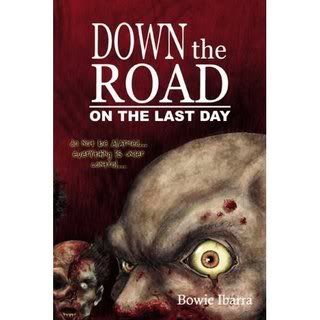
BI: Well, I’ve more or less got the second part of Down the Road finished. It’s called Down the Road: On the Last Day. I anticipate it coming out during or before next spring. I’m currently writing what I like to describe as a ‘slasher’ style novel called “92%”. I won’t give away too much of what it’s about, but it guaranteed to have the usual political implications with the usual blood and lascivious content. I have also been formulating the ideas for the third and final Down the Road called Down the Road: The Fall of Austin. I’m trying to find a publisher for a story I’ve written called Pit Fighters: Baptism by Fire about a stable of no holds barred fighters getting their start. I’d like to turn that story into a series. I’m even considering writing a series of stories called Heroes of the Squared Circle. With the recent success of one of my roller derby family, Melicious, and her book on the sport, I’m even considering writing my stories and experiences in roller derby. But we’ll see about that.
All in all, I’m just trying to live a normal life with my family in this crazy world and provide for them as much as I can and balance my artistic life with that. Quick shout out to my wife Edith Yedida and my baby girl Gwendolyn Maya. I Love you both.
And here’s one to all the people who have supported my work and given my book a chance. Thank you ever so much. I hope you will continue to give my work a chance and best wishes to you all.
And thank you once again, Spiral, for this chance.
Down the Road: The Last Day is now available at Permuted Press! Click here!
10:37 PM - Carlton Mellick III
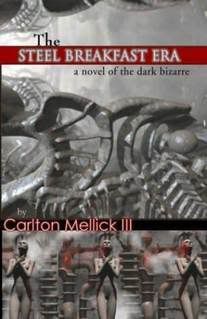
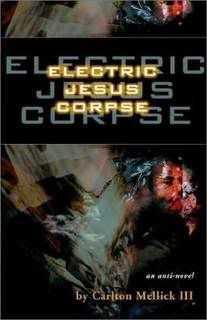
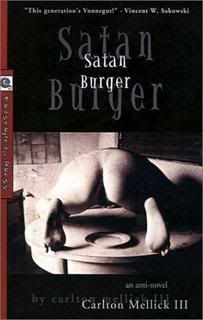
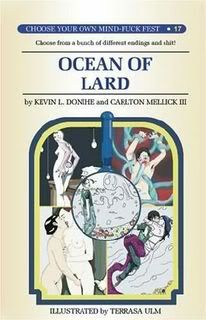
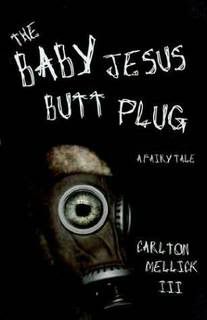
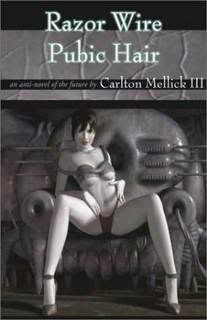
Carlton Mellick, III is the preeminent author of bizarro fiction and a well-known figure in the world of zombie literature. While other writers rehash tired themes that amount to little more than Romero redux, Mellick transcends the genre, elevating it to literary art (albeit, a bloody, visceral literary art). In the past six years, Mellick has published sixteen books. While zombies are woven through the fabric of nearly all his work, his principle “zombie novels” are Steel Breakfast Era and Electric Jesus Corpse, but his novel, Satan Burger (a best-seller on Amazon) was promoted as a “cyberpunk zombie” novel in Russia, and zombies are notably present in Ocean of Lard, The Baby Jesus Butt Plug, and Razor Wire Pubic Hair.
Interview by Dr. Kevin Alexander Boon.
1:54 PM - Jamie Russell
Jamie Russell
By
Kriscinda Meadows
Kriscinda: What was it that made you decide the world needed this book?
Jamie Russell: About five years ago I was re-watching Romero's (then) trilogy and wanting to read more about zombies - what they meant, what kind of fears they were tapping into. Basically, I wanted to read something intelligent about walking corpses. A quick check of the bookshops and the library proved there wasn't anything like that in publication. So I set out to write the book I wanted to read! Then, in the middle of it, this whole ongoing "zombie renaissance" happened and the publishers and I realized we'd picked the perfect moment to start working on this. What was going to be a niche title of just 2,000 copies turned into the best-selling book in the history of FAB Press. I'm still in the process of picking my jaw off the floor...!
K: Describe your research process.
JR: Basically I watched every zombie movie I could possibly find! I spent a lot of time (and money) on EBay, weird classified listings, swapping bootleg videos and stuff like that. I obviously also spent a lot of time in libraries. The British Film Institute library in London was my second home as I went through back issues of mags like Shivers and Fangoria.
K: What do you do when you're not writing books about zombies and did this adversely affect your social life?
JR: My long-suffering wife told me that if she ever had to watch another zombie movie she'd turn me into one! While I was writing the book most people didn't care about these movies. In fact most people thought I was mad. It was: "Why are you writing about zombies, man?" Until about two years ago, nobody wanted to know about walking corpses apart from a few other weirdoes like me. Now everyone wants to talk Braaaains!
K: There are a lot of zombie films out there at this point. How did you go about figuring out which should be showcased in the book and which not?
JR: It was very personal, really. If it engaged me - intellectually, emotionally, or simply with that visceral thrill you sometimes get from marginal cinema it got more space than stuff that left me cold. Basically, if I flt able to talk about it intelligently in detail, it got the space. Which is why something like Shatter Dead gets more attention than The Legend of the 7 Golden Vampires.
K: In the book, you really go into some historical depth regarding the politics of Haiti during the time of White Zombie. How relevant is White Zombie today in light of the current cycle of crisis in Haiti? Do you think Haiti is still fertile ground for zombie movies in the sense of being attractive to modern zombie film fans?
JR: I think Haiti meant more to the genre in the early days, when issues of race and America's imperial mission in Haiti were at their height. The 1930s and the 1940s were the heyday of that kind of thing.
K: Given your knowledge of the zombie film history and its significance, what comments do you have in regards to the current zombie craze and how does it fit within the zombie timeline, socially and/or politically?
JR: The most fascinating thing - and it's something that my book mentions just at the very end - is how the zombie movie has reacted to the War on Terror. A movie like Homecoming (which was released after we went to press) is so intriguing in its use of the zombie as a critique of the Bush administration. Zombie movies have frequently had this leftwing political agenda attached to them (thanks Mr Romero) and it was something I tried to flag up in the book. So to see a movie like Homecoming arrive - with dead zombie soldiers marching on the White House - kind of proved the point I was making. I just wish I could have got it into the first edition of the book.
K: In connection with the last question-the popularity of zombie movies seems to be waning a bit. Do you see any correlation, again, with any current social or political issues?
JR: I don't think zombie movie popularity is waning. Hell, just look at the Hollywood bidding war surrounding Max Brooks' World War Z. Then there's stuff like X-box 36 game Dead Rising, the on-going comic The Dead Walk and Romero's attempts to make another movie (*news of Dairy of the Dead has come out since this interview). The death of the zombie is not yet.
K: At one point in the book, you called Rollins' Grapes of Death (1978) one of the best zombie movies of that decade. Explain?
JR: I loved that movie and I go into great detail explaining why in the book. It's so nasty, so grim - and so unlike your typical Rollin flick.
K: As filmmakers in general (and not just talking about the standards associated with the zombie subgenre), how do our classic zombie directors really stack up?
JR: Across the genre, the standard is very, very poor. We all know this, zombie movies are at the bottom of the horror barrel. They're so cheap to make - grab some friends, slap some ketchup on their faces and film them stumbling around - that every numpty with a camcorder has had a go. Which has really dragged the genre's standard down. At the other end of the spectrum - and I may incur a lot of wrath here - but I don't think Romero is a great director on a technical level. He's very talented, but he's not Martin Scorsese. But then that's not his bag. He's not into pushing the boundaries of cinema. What he is is a writer-director with a fully-realized, unique vision and in that respect he is indeed a director whose name will still be with us in two hundred years time.
K: We'll bring this together with a handful of topical softballs. :)
1. Favorite zombie actor/actress?
JR: Gotta be Howard Sherman as Bub in Day of the Dead. The moment you first realize his moans are actually intelligible bits of dialogue is chilling.
2. Best zombie buffet scene?
JR: The tenement building basement in Dawn of the Dead. Still makes me feel queasy.
3. Funniest moment in a zombie film?
JR: The moment in Children Shouldn't Play with Dead Things when Alan sacrifices one of his actors to save himself. Everyone - even the zombies - stop, utterly shocked by him.
4. Most intellectually stimulating zombie film?
JR: Romero's stuff obviously, The Living Dead at Manchester Morgue (for its sheer nihilism), Dellamorte Dellamore, Fulci's The Beyond (very underrated).
5. Best all around Zombie?
JR: The one who haunts me in my nightmares is the majestic Darby Jones in I Walked With A Zombie.
6. Most effective zombie make-up?
JR: For me, Fulci's Zombi 2.
7. Favorite moment of zombie tool usage?
JR: The zombie bride with a chainsaw in The Video Dead. Rrrrr! Rrrrr!
8. Best dressed zombie?
JR: The buff zombie boys wearing nothing but jock straps and trainers in La Cage aux Zombies.
9. Most memorable line in a zombie film?
JR: "Choke on 'em!" in Day of the Dead.
10. Pick one celebrity you'd like to see come back as a zombie.
JR: George W. Bush. I reckon there'd be a queue of people waiting to shoot him in the head.
K: Describe what you're doing now...
JR: I write for Total Film, Sight & Sound, FHM, BBC Movies and several other publications. And I'm working on a screenplay. Although it doesn't feature any zombies. We're thinking about updating Book of the Dead sometime in 2007, assuming the current flood of zombie movies stops by then.
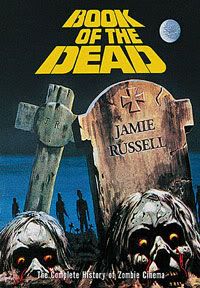
You can purchase a copy of Book of the Dead: The Complete History of Zombie Cinema at FAB Press!
12:07 PM - Roy Boney & Matt Shepherd
Interview with
Roy Boney and Matt Shepherd
by Wayne Simmons
(aka Spiral)
When you pick up a comic published by SLG, you’re going to expect something quirky. This independent publisher has been in operation since 1986, putting out parent-pleasers such as Johnny The Homicidal Maniac and The Super Scary Monster Show.
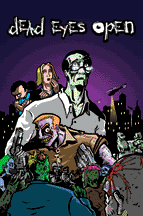
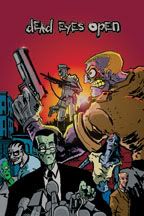
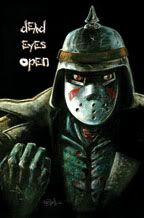
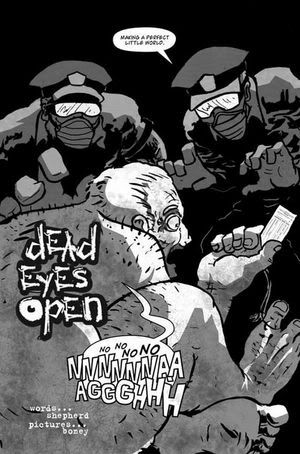
I wasn’t surprised, then, to find their latest title Dead Eyes Open taking that darling of horror, the zombie genre, in a refreshing … and often confusing, new direction. Mind you, after reading Issue #1 I was in no doubt that this bizarre and captivating story was going to hold my attention through its anticipated 6 issue run.
Dead Eyes Open tells the twisted tale of psychologist John. Now, John, at first, seems your everyday family man. He works hard at a job he’s dedicated to, bringing home ample dollars to ensure his wife and little daughter, Julie, have everything they need.
However, one day, it seems, John literally woke up dead. Now, we’re not talking about a really bad hangover here, or a gut-wrenching flu. This is the full deal. The smell, the deterioration, the grey pallor. Yep, John’s dead. His wife knows it, his daughter can tell it (“Daddy, are you going to eat my brains?”), even his somewhat self-consumed clients are beginning to catch on that something’s amiss.
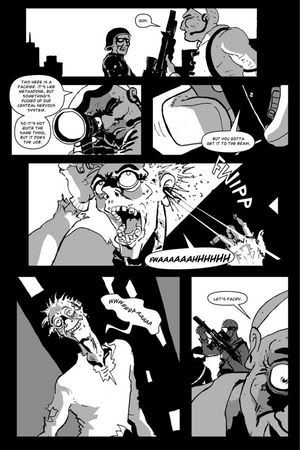
Issue #1 of Dead Eyes Open offers a grand introduction to what promises to be an interesting slice of drama, to say the least. We have a family dealing with change, a daughter dealing with growing pains, some death, murder, genocide, more death and commandoes who…er…also woke up dead.
Wanting to find out more about this incredible premise for a comic, I caught up with creators Roy Boney and Matt Shepherd in cyberspace.
Spiral: Hey guys. Tell us a little about how you got writing together and how the idea for Dead Eyes Open came about.. What influenced you to pen a tale so unique?
Roy: Interesting story on how we "met". Matt and I have never met each other in person, but we've been working together two or three years now. (In fact, it was only recently that we spoke on the phone for the first time regarding a now tragically defunct media exploitation deal.) I used to do an online comic called Plugin Boy at Keenspace (http://pluginboy.com) and one day Matt emailed me telling me he enjoyed my work. I also happened to be a mutual fan of his Man-Man Comic ( along with artist James Duncan at http://man-man.org), also at Keenspace. That's how I came across his work. From there, we kept in contact and one day Matt mentioned this project he wanted to shop around with publishers. There was also another project of his we started doing preliminary work on which was a twisted view of the apocalypse and Jesus' lineage. That somehow led to Dead Eyes Open, but it at its inception, it was called Deadies. We've had quite an adventure with it thus far, having pulled its original debut from another webcomics collective to eventually have Slave Labor Graphics pick it up where we had to change the name of the book. Last year, we collaborated together on the GraphicSmash.com series The License.
Matt: Regarding the idea for the comic, it started as a joke. Some friend of mine and I were talking about zombies and how they should unionize, and that actually led to me thinking "well, what if they did?" and what zombies would strike over. "MORE BRAINS SHORTER HOURS," that sort of thing. But that kind of pointed out one of the "soft points" in the whole zombie canon: there's no particular reason that they're stupid. From there, things sort of developed. Oddly, all of this was being worked on before 28 Days Later and the Dawn of the Dead remake, so when those movies came out (I know, I know, it's the "infected" in 28 Days Later, whatever) I was living in mortal terror that somebody would come out with "smart zombies" before the book came out and we'd just look like a rip-off.
SP: I would see Dead Eyes Open as a novel take on the zombie genre. Your leading man is, for all intents and purposes, not only a zombie, but a zombie who is both intelligent (working as a psychologist) and family orientated.. What inspired you to create this character?
Matt: He wasn't the original main character -- our original comic pitch was for a series of unrelated vignettes, all moving the "world" forward six months at a time, but our publisher felt (and rightly, I think) that a comic book by two unknown creators with no protaganist wouldn't find an audience. So Roy and I had to find a main character, both enough of an everyman that the reader can identify with him but also somebody in a position to witness some of the massive changes the world is undergoing first-hand. As you'll see in the second issue, John quickly winds up in that position. But originally, he was just "daddy" in the initial story, the one we posted on the Web. The focus on that story is Julie, his daughter -- for John, I just wanted a nice guy. The psychologist part got added later when I had to give John a job that would provide him with baseline qualifications for -- something that happens in the second issue -- and as I'm a sucker for irony, I liked the idea of a therapist who can't connect to his own family.
SP: Was it intentional to set this sci-fi/ horror tale into a fairly normal/ everyday context?
Roy: Yeah, based on Matt's initial description of it, it was always in my mind a normal, everyday story except with the undead.
Matt: Yes... again, the original idea was to have vignettes focusing on "ordinary people" as a lens to see the world changing. I like stories where the protagonists could be you, instead of being some sort of James Bondian ultra-hero, so I wanted the series to look at accountants and traffic cops and doctors, not secret agents and military leaders and super-cops. That just carried over to the series revamp, but keeping it grounded is very important. You need to set a certain degree of plausibility before everything just goes nuts. It gives everyone -- especially me -- a point of reference for how crazy things are becoming.
SP: The idea of being a ‘freak’ comes up in both DEO #1 and the online freebie Happy Birthday Angel. Both John’s clients and his daughter have difficulties adjusting to his change. The character of Freaky Kenny in Julie’s school almost seems to mirror her father. Is the comic in any way a metaphor about being and feeling ‘different’ to those around you?
Roy: I don't want to sound like the "tortured artist" or anything, but yeah, for me it has that take on it. I'm pretty used to sorta existing on the fringe.
Matt: Absolutely. But a lot of it also has to do with what makes you you, and how much our perception of people is based on ... not superficial things, but things we don't really claim are important. If you're dead, but still thinking, are you still you? Do you keep your job? Do you keep your family? And if they're repulsed by the "new you...." is that wrong of them? What, at the end of the day, is at the core of what you consider your "self? The comic is partly about being different and having to live with that, but it's also about how being different can be empowering, by the end of the series. You're going to see a lot more Returners and a lot of changes to how the world works by the end of Issue #6.
SP: DEO crosses various genres within its first issue. At times it’s dark sitcom, at other times we have sci-fi/ horror and towards the end we see a lot of action. How would you describe the comic for potential readers?
Roy: "The Thinking Person's Zombie Book but not Boring."
Matt: A sociopolitical satire family drama with zombies. Roy and I both knew from the get-go that this book might have trouble finding its audience ... a lot of "traditional" zombie fans don't have much interest in serious human drama, but people who are into political intrigue (see issue 2) and interpersonal relationships don't see themselves as "zombie" readers a lot of the time. It bridges two genres, and hopefully we'll attract a little from column A and a little column B, rather than just pissing off people on both sides.
SP: Roy, I would describe your art as both kitsch and melancholic. Its attention to facial expressions amplifies the emotional turmoil within each character’s plight. Can you tell us about some of your influences?
Roy: I'm a big fan of old black and white films and old comics like the EC horror and crime stories. Wally Wood, Reed Crandall and Bernard Krigstein are some of my favorite artists from that era. I'm also highly influenced by films. Fritz Lang's M has got to be one of the coolest looking films ever. A Touch of Evil by Orson Welles is another one my stylistic favorites. But I'm also a big fan of the kitschy stuff like those old 50 and 60s motorcycle films, and, of course, horror films particularly Fulci's Zombie.
SP: What led to your decision to present the comic in black and white?
Roy: The publisher. LOL.
SP: Dead Eyes Open #1 is quite a roller coaster of an issue, closing with the introduction of what appear to be Zombie Commandos. What can we expect from DEO #2?
Roy: More action, and a major twist.
Matt: You can expect some major story shifts in #2.
SP: What are your hopes for the future with this comic?
Roy: I'd like to hope it'll be relatively well received. Perhaps we could tell the stories of other Returners in a future series or maybe some one-shots.
Matt: Once the last issue (#6) comes out, the story will be wrapped pretty conclusively, but I still like the vignette idea and have a passel of scripts for it. I'd love to revisit the world with parallel issues in a second series that flesh out (har har) some of the dozens of things that get touched on in the main story.
SP: Could you give us a top ten list of zombie films? (Feel free to stick in some comics if you need to make up the ten)
Roy:
1. Night of the Living Dead (the '68 version, of course)
2. Dawn of the Dead (original)
3. Day of the Dead
4. Zombie
5. The Return of the Blind Dead (not sure if it could be called a real "zombie" film, but it's campy)
6. Night of the Zombies (a.k.a Battalion of the Living Dead)
7. Dead Alive
8. Return of the Living Dead (some of my friends yell blasphemy when I say that)
9. 28 Days Later
10. The Walking Dead (comic)
Matt: Hmmm.
Not in any really strong order:
1. Night of the Living Dead '68
2. Walking Dead (comic, and not to flesh out the list, I'd put it toe-to-toe with any zombie classic)
3. Cemetery Man / Dellamore Dellamorte (truly, honestly, awesome)
4. Dead Alive
5. Dead and Breakfast, which I just saw at the Toronto horror con -- flawed, but a lot of fun
6. Dawn of the Dead (original)
7. 28 Days Later
8. Zombi
9. Evil Dead II (hmm... maybe not quite zombie, but I like it)
10. The Incredibly Strange Creatures Who Stopped Living And Became Mixed-Up Zombies”
Dead Eyes Open is published through SLG Publishing
www.deadeyesopen.com
11:32 AM - David Moody
David Moody
by
Wayne Simmons
(aka Spiral)
I rarely get a chance to enjoy sunshine. It’s an Irish thing. Sure we have the odd good day here and there, the occasional ice cream in the park, one or two lazy Sunday afternoons spent lounging on a deck chair, swatting wasps with a newspaper…
…But before you know it, Autumn creeps in...
In its trail, decay reigns. Leaves turn a sickly yellow and crumble lifelessly. Flowers lie rotting around the roots of bushes that flourished through the summer. Branches everywhere appear barren and ghoul-like, shedding almost every sign of life to become skeletal shadows of their former selves. In autumn, the only thing to thrive is the cold night air and ever-increasing darkness…
This is the world into which David Moody introduces us to his apocalypse. Fitting, really, to have the human race join the rest of nature rotting on the ground. Strange, though, that Moody’s human race soon get on their feet again, no longer withering and fermenting on the ground amongst the flowers and leaves. Instead they’re rotting as they walk, slowly reanimating to become primal and deadly shadows of their former selves. Meet David Moody’s zombies.
I met them online about six months ago. I had been trawling through the web, trying desparately to find quality writing on the well-oiled genre of zombie apocalypse. Everyone and their undead dog were at it. Fan-fiction, short stories, comics, remakes, rewrites aplenty. There was no shortage of material, but there was something of a famine when it came to quality material. I was close to throwing in the towel when I happened upon David Moody’s infected.
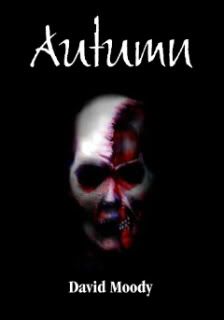
Here was a writer so confident of his work that he was offering his first novel as a free download. Wary of a catch, I checked for small print. Still somewhat suspicious, I downloaded Autumn and set about reading from my computer screen. Within a couple of hours, I’d not only greedily devoured every word of David’s first instalment in the Autumn trilogy, but also ordered the second. A few short months down the line and I had worked through every book in the Autumn series and anything else Moody had penned.
I was hooked. Hooked by a refreshingly normal bunch of disparate survivors, hooked by an almost credible, cheddar-free, undead horde set amongst Moody’s English landscape. Hooked by powerful and compelling writing, the like of which I hadn’t enjoyed since reading Richard Matheson’s I am Legend.
When I caught up with David in cyberspace, I discovered a man as delightfully human as the survivors in his undead trilogy. Married with four children (’I live with five women - now you can see why I write about death, destruction and misery??!’), David has his gripes and grumbles like the rest of us (’I’m sick of contrived, happy-endings and square-jawed, all-American heroes.. The current spate of remakes of perfectly good horror films..’) However his passion for both the horror genre and writing is obvious. An aspiring writer myself, I was keen to find out how David’s novel approach to becoming a author had developed just as much as the Autumn trilogy itself.
----------
Spiral: You have gone about distribution and publicity in an interesting way giving your first book away for free and largely handling the whole process yourself principally over the Internet. Other authors in niche areas (like this sub-genre and others) have said how important the Web is for them - has your approach worked as well as you expected?
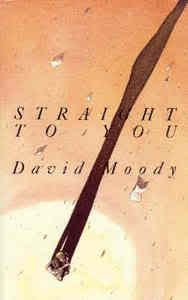
David Moody: After the release of Straight to You (David’s first novel) through a ‘traditional’ publisher in 1996 I did a lot of thinking. Like 99% of the books published each year, it didn’t make the best-seller list. In fact, it didn’t make any kind of list! By the time Autumn was finished the Internet was thriving and it seemed an obvious solution – a low cost advertising medium with the potential to reach just about anyone, anywhere. I made contact with a few people who steered me in the right direction with eBooks and everything has evolved organically from there.
The free novel principle was a logical step for me to take. Before Autumn no-one had heard of me, so the chances of them wanting to read and buy my books would have been pretty much zero. Think about it for a second – would you buy a book or a CD or DVD by someone you’d never heard of? I probably wouldn’t without a recommendation. At the same time, it’s human nature to grab anything you can get for free, even if you don’t need it! Offering the first Autumn book as a free download gave me a way of getting people into my work at no risk to them and relatively little cost to me. From a marketing point of view, I knew that there would be at least two more books in the Autumn series – my business logic said if I gave people the first book, some of them would go on to buy the second and the third etc. and that’s worked.
SP: You mention on the blurb of Straight to You that you are interested in 1950’s horror movies. Could you give us a couple of examples of the films you mean?
DM: I love horror films from any era, but there’s something special about films made in the late 50’s by people like Roger Corman and Samuel Z Arkoff etc. like The Last Man on Earth, The Day the World Ended and Brain from Planet Aros. I guess it’s the lack of pretence that appeals, and the fact that so many of them have an apocalyptic theme.
SP: How have these films influenced your writing?
DM: How people and society in general would react to an impending / happening Armageddon fascinates me and it’s something that runs through much of my work. Most people today, however, can’t see past the cheesy production values and hammy acting in these films, and they fail to appreciate that they entertain (perhaps for the wrong reasons) and that some of them actually have something relevant and important to say.
SP: Straight to You is written from the perspective of a bank manager at 26. Obviously that would have been your own situation not too long ago. How much of yourself do you put into writing?
DM: The character was very definitely me at that particular stage in my life, but I haven’t written anything else as blatantly autobiographical since. Obviously the plots of my books are entirely fictional, but the locations I write about and the characters which inhabit them are all based on people I’ve met and places I’ve been to (with, of course, the names changed to protect the innocent!) During my time with the bank I worked in a number of large processing centres around the country and I looked after literally hundreds of staff over the years. They used to joke about appearing in my novels, and now many of them have!
SP: The Autumn trilogy, particularly the first in the series, would draw some influence from the films of George A. Romero. Are you a fan of George’s work, or indeed, the zombie genre?
DM: Romero is a hero. Without Night of the Living Dead I don’t believe there would be a zombie genre to speak of. He set the rules and the standards for everything that followed. I was very young (too young) when I first saw Night – I watched it with a group of friends in darkness during a massive thunderstorm – and it left a huge impression on me. Like many people, though, I have to say that I found Land of the Dead to be an enormous disappointment. I thought it was a weak and nonsensical story that added nothing to the genre. I can‘t understand why, after setting the bench-mark himself for so many years, Romero felt the need to make a film which seemed more influenced by the current crop of zombie films than his own original legendary trilogy.
SP: What attracted you to writing about these creatures?
DM: Without a doubt zombies are the greatest of all movie monsters, but they’re also probably the easiest to present on screen and, unfortunately, the easiest to screw-up. For every decent zombie film there are probably 10+ awful ones, and that often casts the whole genre in a bad light. Inspired by Romero, in my books I try to make even the most unbelievable subjects seem plausible and possible. But where Romero concentrated each of his original three films on a small group of survivors, through the course of the series I’ve tried to show the effect of the disaster on a much wider scale. The most unnerving aspect of the living dead is (to quote a film – can’t remember which one) ‘they are us and we are them’. Zombies terrify me because we spend pretty much all of our time surrounded by them. Anyone is a potential victim and, therefore, also a potential zombie. And if the unthinkable happened, how would we cope? I imagine I could handle disposing of the bloke who lives next door (God knows I’ve been tempted) but how would I deal with having to destroy something that used to be my wife, or my brother, or my parent or even my child? It’s those kinds of questions that fascinate me and which have kept me writing about the living dead for the last five years.
SP: You seem to go into a lot of detail about the actual struggle for survival of Steve in Straight to you and your disparate group of humans in the Autumn books. Would you see this as in any way an important metaphor for the human race’s plight in general?
DM: Most people seem to take their continued existence for granted without realising just how fragile their precious little realities actually are. The fact of the matter is that it doesn’t take much to turn everything upside down. You only have to look at world events over the last few years to see how true that can be. In the overall scheme of things, as a species we’re pretty bloody insignificant! In comparison to the lifespan of the planet we live on, our individual lives are over in the blinking of an eye. That’s really the theme I’ve tried to expand on in the Autumn books, particularly the last two volumes. Without giving too much away, towards the end of the original trilogy some of the characters begin to question why they’re running and why they’re struggling to survive when the odds are continually stacked against them. What’s the point? Why bother? We’re programmed by society to try and keep going, and in essence that’s the ‘Human Condition’ I write about. I think it’s also the reason why my instinct-driven dead bodies continue to drag themselves around pointlessly. It’s what they always used to do…
SP: What attracts me most to the Autumn series is that the survivors are very real. They are not glamorous or naturally heroic. Rather they are flawed characters with their own strengths and weaknesses, hopes and fears. We have representations from all parts of society in there.
DM: I’ve always made my characters everyday people – people like you and me or your next-door neighbour or the guy across the street. I think that by concentrating on ‘regular’ people and locations my books become more believable and it’s easier for readers to be able to identify with events and become absorbed in the story. A lot of fiction tends to dwell on perfect, skilled, enigmatic, beautiful people to save the day. In my books I write about ‘real’ people and, if we’re honest, most real people are flawed, aren’t they?
SP: Was it intentional to have some of the less likeable characters escape?
DM: I try to make the actions of my characters believable, and that inevitably means that some people will end up looking out for themselves at the expense of others. I guess that’s why some of the less likeable characters survive. It’s self preservation. Because they’re so self-centred they manage to keep themselves out of trouble and avoid putting themselves at risk. The reverse of that logic also applies and the decent people – the folks you really want to make it – often don’t. That’s certainly true of events in Autumn: Purification.
SP: Phil Croft, the smoking medic, was one of my favourite characters in the series. We watched him get more and more jaded as time went on, soon losing sight of his medical vow to help preserve the lives of others. Did you have any favourite characters which you particularly liked?
DM: I also liked Phil. I think he’s the one who realises sooner than anyone else that the situation these people find themselves in is ultimately hopeless. The change in his attitude throughout the story is mirrored by the rest of the group, but they take a lot longer to come to the same conclusions and realisations. I also like Jim Harper, one of the incidental characters from Purification because the death of the rest of the world is actually something of a blessing to him and in a perverse way he’s quietly thankful.
SP: Which of the characters in the Autumn series do you most see yourself in?
DM: I have to be very predictable here and admit that Michael is the character closest to me. Throughout the writing of the books I often thought ‘what would I do here?’ and Michael’s reactions frequently mirrored my own.
SP: You’ve just released a companion/ sequel to the original Autumn trilogy. Are there any plans to continue the series in the future?
DM: I intended to finish the series with The Human Condition but I’ve since had a change of heart. I’m presently working on Autumn: Disintegration which is a new novel set in the Autumn world but completely separate to any of the previous books. As long as I can find something interesting and different to say and there are characters worth writing about I think I’ll probably keep churning the books out! That’s assuming people keep reading them!
SP: Have you any plans to look at any other mediums, such as comics/ animation/ film to tell any of the Autumn story?
DM: Absolutely. I’m very interested in a comic book adaptation. Some of the short stories featured in The Human Condition would work brilliantly. If any artists reading this are genuinely interested, please get in touch! I originally envisaged the first book as a film and I‘ve written the first treatment of a screenplay. Infected Books will, I hope, soon be followed by Infected Films!
SP: What are you working on now?
DM: Apart from Autumn: Disintegration (which I hope to release in July 2006) I’m currently also writing Hater, the first book in a new horror series. It’s not a zombie story, but some of the themes are similar and it should be out in April / May this year. For reasons which I won’t explain yet, the world is rocked by a sudden epidemic of random, unprovoked and apparently unconnected violent physical attacks on individuals. The book follows an average family as society quickly falls apart around them. There’s not a lot of trust around in the world at the moment, but imagine if you couldn’t even trust the people closest to you because you’re terrified that they might kill you… Imagine not wanting to be with the people you love because you’re scared of them and you’re also scared of what you might do to them… I also have an ongoing serialisation (Mark Thane) in progress at www.djmoody.co.uk, a children’s horror novel in the last stages of development and a couple of other books, which are in the early planning stages.
SP: What recommendations would you give authors thinking of following a similar approach?
DM: Go for it! This has been the most incredible ride and to sit back now and look at what I’ve achieved with Autumn so far is great. I think that the Internet has allowed everyone to compete on a level playing field for the first time.
SP: Any general advice for any writers who are just getting started? Possibly things you learned the hard way?
DM: A few things. Firstly, don’t expect to achieve everything overnight. It takes time to finish any piece of writing and to build a name and reputation for yourself. Don’t give up! Secondly, be professional – don’t settle for second best and learn to take criticism on the chin even though it hurts. Thirdly, write for yourself. I don’t believe you can make any writing interesting for readers if you’re not happy to sit and read it yourself.
SP: Finally, have you a top-ten list of zombie films?
DM: I wracked my brain but couldn’t think of my top-ten zombie films. Instead here are some comments on various mainstream zombie films, which have influenced me or just made me think!
1. Night of the Living Dead (original) – revolutionary. Deserves the top-spot purely because of the effect it had on the modern horror film in general. Broke the mould in so many ways – the hero, the downbeat ending and the lack of optimism and hope etc. etc.
2. Dawn of the Dead (original) – as Aliens was to Alien, Dawn is as good as Night because it’s so different. A great portrayal (particularly in the opening scenes) of a world going into meltdown.
3. Day of the Dead – obviously restrained by the low budget Romero was given, but an excellent drama nevertheless. Can’t help wondering what this would have been like if he’d had the money…As I mentioned earlier, it’s a shame that Land of the Dead was so bloody awful because it’s tainted the legend of the original trilogy. I try not to think about it…
4. Remakes of the above three (and any other remake, come to think of it) - why do they do it? Apart from wanting to make money and exploit the genre’s huge fan-base, are there any valid reasons for remaking these films? There are huge numbers of new and original zombie stories and ideas circulating at the moment. Like most areas of the entertainment industry, though, the vast majority of film studios are more interested in profit and product than producing anything of any artistic worth.
5. Shaun of the Dead - original and hilarious. This deserves a place in any list because it’s actually a clever and intelligent (and bloody funny) piece of film-making. It works because it’s doesn’t play the zombies for (many) laughs. At its heart it’s a straight zombie apocalypse film that just happens to have a couple of idiots in starring roles.
6. 28 days later – had to mention this because of the hundreds of emails I got when it first came out. Was it inspired by Autumn at all? I have no idea. There are some scenes which make me wonder… Wherever the inspiration came from, I love the tone and feel of the film, until the final reel. In my opinion it has one of the most disappointing endings in film history. I’m not convinced that we need the forthcoming 28 weeks later but I won‘t complain if it stirs up the debate about Autumn again!
7. Italian zombie films – a huge generalisation but, sorry, they don’t do anything for me. As a writer who goes for realism, any mention of voodoo and cannibalism immediately makes me switch off.
8. Return of the Living Dead – part one – original and fun, part two – not original and less fun, part three – excellent because it’s so different.
9. Brain Dead – Incredible energy, great laughs and huge amounts of gore! I also admire Jackson hugely because of his first film, Bad Taste, which he made in a similar way to the way I’ve published the Autumn books (i.e. on his own!)
10. Resident Evil 1 and 2 – part one – shit, part two – more shit. Why have I included these? Just because they’re a prime example of how not to do it.
David Moody’s ‘Autumn’ trilogy is available on E-Book or paperback form from his website ‘www.theinfected.co.uk.’ There you can download the first novel in the series for free. His work is also available through Amazon.com
6:58 PM - Andre Duza
I heard a lot about Dead Bitch Army before actually daring to read it... Reviews and hearsay cited this indie horror book as more than just horror... It was whispered of with the same mix of trepidation, excitement and downright disgust that would ordinarily be reserved for hardcore porn. And that's about right.. because Andre Duza's Dead Bitch Army certainly is hardcore...
Bloody Mary is the tale's elusive anti-hero, the only undead corpse to exude sex appeal and star in her own steamy shower scene. Together with her merry band of generation terrorists, the Gas Mask Mafia, she sets out on a savage spree of torture and mayhem which makes a film such as Natural Born Killers look like a nursery ryhme. Pitted against her are two women, fucked up enough themselves to make it difficult to determine just who you should be rooting for as a reader. But will anyone be strong and brutal enough to stop the Dead Bitch herald in her new and chaotic world order?
This is sick stuff, beautifully written by Duza, interwoven with a tapestry of delightfully varied artists' impressions of the Dead Bitch. The style of writing is captivating, drawing you into a sick fantasy of gratuitous violence and compelling characters with surprising ease. You'll be hard pushed to set this down once you start reading.
There's pretty much everything to soak up, sordid dark humour and intricately choreographed death scenes blending effortlessly with a subtle-as-a-brick commentary on Western Society TM's obsession with image. By the end of the story, you're almost ready to believe that Bloody Mary's Vicious New Age would be almost preferable to the rampant apathy and injustice rife in our world today.
Dead Bitch Army is potent, damn-fine, guilty fun, evoking nervous and nauseous laughter with every victim's demise in a way that'll keep you on your knees in penance and Hail (Bloody?) Marys for some time to come. With Indie Gods upcoming release of a limited run of Dead Bitch Army graphic novels, you'll be paddling in Duza's sordid sea of imagery to your black heart's content...
I caught up with Andre in cyberspace, keen to uncover any dirty secrets ... or the Dead Bitch's phone number...
Spiral: Tell us a little about yourself, Andre, and how you came to be an author within the horror genre.
Andre Duza: You are an overly inquisitive kid in a narrow-minded environment. You live in a small row-home with few windows. Mixed with the atmosphere of religious devotion, the dim lighting gives the place a gloomy, overly serious vibe. The house is made even smaller by too much furniture, some of which is covered in plastic that bites, and too many people―you, three very sheltered women, and their alcoholic, war-veteran father. You occasionally watch him beat them like he would a man. Sometimes he beats you too.
Eventually it gets so bad that your mother (who can’t afford to move) moves to a bad neighborhood. Along with the surreal, colorful ambiance, and the spirit of bastardized rebellion that most films about the hood neglect to show, you see violence constantly.
One day while riding the bus to church you watch a Native American guy stab a drunk white guy in the face repeatedly for calling him names like Chief, Tonto, Keemosabee. A few things stand out; the way the drunk man’s skin bunches around the blade and pulls taught like a tent as the Native American guy works the knife around inside the wounds; how the Native American guy’s hand is redirected when the knife hits bone; how the drunk guy remains conscious through the whole thing. Usually in the movies it’s one stab and you’re out. That experience really opens your eyes to the difference between real and movie violence.
Another time you watch the wife of a Korean grocer carry her husband’s bloody corpse out into the street after he is shot in the head during a hold-up. She yells hysterically (in Korean) at the people who are standing around watching. Nobody does anything. Some people even laugh at her.
Another time while going to church you are abducted by a child molester, but you manage to escape with your life.
You develop fantasies of revenge. It drastically changes your attitude. You go through your harming animals phase. You begin to lash out at family, friends, and teachers. You break things, attack people with weapons, etc.
Your mother tries everything. She takes you to a shrink who has a harelip. As easily distracted as you are, weird little details like that spell doom for the therapy sessions. The one good thing you take away from it is his advice to write down your feelings.
Next, your mother signs you up for an informal version of the ‘Big Brothers’ program that is run by the church. Your ‘Big Brother’ turns out to be a boxing trainer. He introduces you to it, and it actually helps calm you down a bit. At the time, the discipline to keep it up just isn’t there, though.
Eventually your mother sends you to a boarding school to hopefully straighten you out. The place is like its own self-contained world, with huge marble structures and a rich racist history. You continue to nurture your violent streak with horror (books, movies), which you develop a sort of an obsession with. In a way, it serves as therapy for your violent tendencies, however you continue to act out.
You attack one teacher with a broken hockey stick and slice his arms up pretty good. You attack another teacher with a cleaver. You light a cheapo Rambo knife on fire using a foam latex kit (At the time you wanted to be the next Tom Savini) and attack one of your close friends. The school hires another shrink, but you are too stubborn to listen to anything.
Being a smarter than average kid underneath all the anger, you realize where the path you’re traveling down leads to, so you try to deal with it somehow. You remember how the boxing training really calmed you for a bit, so decide to try martial arts. It’s then that you finally get a grip on your anger and learn to channel it into something constructive. You have been expressing your feelings through wild, disjointed stories (that started out as journal entries) since you were a kid, but now they have purpose, meaning. You fall head over heels in love with words…
That about sums it up.
I tried for about 10 years to get Dead Bitch Army published. Before that, I had an anthology called MindPhucked and Left to Die that had been making the rounds.
There were a few bites along the way for both, but they either wanted me to change the titles or tone things down a bit. Fuck that! I eventually gave up on the anthology and decided to focus on DBA. I was pretty fed up with the whole process. Then I got an email from Carlton Mellick III. I had mentioned my frustration with this whole title thing in my query to Eraserhead Press. The first line of his email was, “Don’t you dare change that title.”
Sp: What films, comics and/ or books have most influenced your writing?
AD: Well, I’ve always been more a fan of reality-based horror―the news (I’m a news/political junkie), serial killers, etc.
I was also obsessed with ghosts and UFOs and shit like that. I would sit in the library for hours reading up on it. The first novel I read was Jay Anson’s The Amityville Horror. I found it in the closet where my mom kept her “scary” books. I also found William Peter Blatty’s The Exorcist, there.
When I was a teenager, I was big into Fangoria. I would read it front to back, over and over. At some point, I remember reading Gary Brandner’s The Howling series. I loved the world he created with those books. It’s entirely different from Joe Dante’s film version, which also happens to be one of my favorite movies.
As far as comics, I was into Daredevil, The Avengers, Conan, EC horror stuff.
I like all kinds of movies, good and bad; sometimes the worst, the better. As long as it has some kind of vision, or sense of style. It might not be my thing, but if the talent is there, I can appreciate it. Sometimes all it takes is a good soundtrack to get me hooked. I’m a big fan of movie soundtracks.
Some of my favorite movies are: The Texas Chainsaw Massacre I & II, Night of the Living Dead (Both versions), Dawn of the Dead (original, although I thought the remake was good. They just should’ve called it something else), The Good, The Bad, and The Ugly, Near Dark, Scanners, Martin, Old Shaw Brothers Classics like, Chinese Super Ninjas, Five Deadly Venoms, and Kid With the Golden Arm, The Howling, Brain Damage, Re-animator, Phantasm, Friday the 13th 1-4, Halloween, The Thing (81), Raising Arizona, Lady in a Cage, Henry, Body Double, Three The Hard Way, Foxy Brown, Uptown Saturday Night, Kubrick’s The Shining, Full Metal Jacket, Repo Man, Return of the Living Dead, Death Race 2000, Sexy Beast, Ravenous, etc.
I was also inspired by Hip-Hop. Not the Minstrel bullshit that pollutes the media now, but the old stuff that spoke to real feelings that until then hadn’t been explored.
Sp: Describe Dead Bitch Army to a potential reader in 10 words or less.
AD: To quote Nick Cato from the Horror Fiction Review, “The ultimate midnight movie.”
SP: Zombies are rarely portrayed as leaders in myth or contemporary fiction/ film… what inspired you to create a character, therefore, such as Bloody Mary?
AD: The Dead Bitch was inspired by many different things; the unstoppable, masked 80's killer; a zombie; a gothic superhero; my wife, and this painting that my mom had hanging over her bed when I was a kid. The character had been floating around in my head for years. It started out as a short story that was more directly related to the painting over my mom’s bed. The story was called “More Beautiful Than.” Over time I just kept adding to the story until it became what is it now.
SP: Racism and perceptions of what racism is and/or isn’t seems to play an integral part to the telling of much of Dead Bitch Army’s story… Has growing up in Philadelphia led, in some part, to you weaving such into your writing?
AD: Well, it’s not a conscious thing. My stories are often (but not always) inspired by my feelings about something. Coming from where I did, race seemed to be a logical starting point, but it’s not something that I wear on my sleeve. I’m all about the world community, man. Too much emphasis on racial, religious, and cultural distinctions is a big part of the problem with society.
SP: The characters in Dead Bitch Army often seem damaged psychologically beyond repair… It’s difficult to find anyone who is completely likeable, or completely unlikeable. Was it your intention to create characters as ‘grey’ as this? What would you say to the reader who asks you where the square-jawed hero is in this novel?
AD: No one is all good or all bad. No one. That’s just the way we humans work. I think we’ve lulled ourselves into thinking in terms of ultimate good and ultimate evil because it makes it easier for us as a society to judge the actions that they inspire; rewarding the good deeds and punishing the evil ones. Or maybe in terms of violence, it helps some people to deal with something that they might find horrific beyond their comprehension.
You hear people say things like, “Those eyes… They were filled with pure evil,” in reference to a serial killer. We classify them as “an animal.”
Deep down we know it’s all bullshit. We know this guy could be our neighbor or friend, or family member and we might never even be the wiser. Stamping them evil once we weed them out helps to anesthetize the discomfort that the brutality of their crimes, or their lack of anything resembling remorse brings about in us.
I find that grey area to be an interesting place to visit and explore. It’s generally a more honest, uninhibited place, full painful secrets, and titillating ones.
SP: What are you working on now?
AD: My second novel, JESUS FREAKS (jē'zәs frēks), n. see ZOMBIE is coming out in January. It’s an apocalyptic zombie tale with a twist. It features a mix of Romero-style shamblers and fast-moving zombies that are able to think and speak to some degree.
I’ll been writing the introduction for Permuted Press’ reissue of Travis Adkins’ zombie hit, Twilight of the Dead. That should be a fun project.
Beyond that, it’s all a matter of choosing between a few novels I have in various stages of completion. The two that stand out are SuperNigger: and other tales from the Toxic Brothers Circus, and Aries the Dog. Also, support Bizarro: a genre of film and literature.
SP: Might we see any other books based in the Dead Bitch world, for example a sequel?
AD: I’m currently working on an anthology set in the DBA world entitled, Necro-Sex Machine: The Dead Bitch Chronicles Vol. 1. Then, of course, there’s the at Indie Gods. Dead Bitch Army Graphic NovelDBA will be their last comic title.
There is also the Indie Gods chapbook featuring my story Dead Bitch Walking along with David Zuzelo’s Ascension of the Blind Dead. You can order a copy here and here, where the chapbook is listed under their New Voices Guarantee.
Queen Bitch will be the title of the DBA sequel. The story is all worked out in my head, but I’d like to put out a few more original titles before I actually sit down and write it. There is definitely more story to tell with both DBA and Jesus Freaks.
One of the stories in Necro-Sex Machine (called The Devil Has a Vagina) takes place a few years after the events at the end of DBA, just to give everyone a hint at what the sequel might be like. I’ll also be including the short story that started it all (More Beautiful Than…) in the anthology.
9:02 AM - Conor McMahon
Picture the scene. You’re in a fancy restaurant with your girlfriend. The waitress takes your order, smiling politely as waitresses tend to do. You ask for the sea bass, only without the tomato salsa dressing (you’ve got a childhood phobia of the damn things) and your lovely belle requests some posh chicken thing-or-other.
Two cigarettes and a glass of wine later, the waitress arrives with your food. Both you and your girlfriend smile excitedly, thanking her profusely whilst stubbing out the ciggies. However, as soon as her back’s turned, you’re both complaining in hushed whispers. There’s tomato dressing on your fish and your girlfriend thinks her food looks more like a dog’s dinner than one fit for a princess (“I thought this was meant to be a top class restaurant?!”)… but neither of you complain. You smile and make do, then blush whilst telling the waitress that your unfinished food was delicious and that you’re just so full you couldn’t finish it. You pay the extravagant bill, tipping generously, then wander onto the street. You call the waitress a sour old bitch and declare you’ll never go into that hole again… Sound familiar? Yes? Ah, you must have green blood in you, then!
You see, we’re a funny bunch us Irish. A race of paradoxes. An insecure people full of good intentions, which have rolled out in bloody civil ’unrest’ for as long as any of us remember. We hate each other. We love each other. We hate ourselves, then we get blind drunk and love ourselves. We never complain. We always complain…
No horror film I have seen captures The Irish paradox ™ as much as Dead Meat. The title itself would have been for me something heard bandied about in Irish playgrounds circa 1985. It was a threat rarely said in jest, yet never carried out. You said it to some wee lad who was your best mate one day and worst enemy the next…
“YOU’RE DEAD MEAT!!”
… Fitting, then, for Dead Meat to be the title for a movie as much about the humour as it is about the horror…
Conor McMahon chose to make a zombie film that was unapologetically Irish in terms of dialogue and characters. His leading lady, therefore, is French… or is it Spanish? Either way, it makes about as much sense to find a European in this film as any word spoken by the coach or his monosyllabic wife makes... (When you see the film, you’ll know what I mean. Trust me…)
Yet it all makes perfect sense. The archaic blend of gore, kung-fu spade wielding, brash Irish dialogue and Spanish totty that is Dead Meat for me represents the most exhilarating piece of survival horror since 28 Days Later. Set in rural Ireland, the countryside backdrop provides ample space for this modest budget zombie flick to both amble and thrust itself into your imagination, reaching an inevitable conclusion which says more about human nature than that of the hapless hordes of undead creating merry trouble for our eclectic band of nitwits and French (?!) doll.
I was delighted to catch up with the director of Dead Meat, Conor McMahon, an Irishman by name and nature, to find out what the craic was…
Spiral: Hi Conor. What moved you to pen and direct another zombie film within an already saturated market? What do you think makes Dead Meat unique?
Conor McMahon: Well first of all when I started writing Dead Meat no zombie films had come out yet. I started writing the film a few months before I even heard of 28 days later. And then it was when we were filming that all the other zombie films started appearing. So it goes to show you can never predict what the market is going to be like. I guess the reason I thought about writing a zombie film in the first place was because I hadn't seen one in so long. (A lot of people must have had the exact same idea). Plus I had made a lot of horror shorts but I had never made a zombie one. And I thought if I do a zombie film I can have a load of death scenes and I should be able to drag that out over an hour and a half.
I think the Irish humour is the most unique part about the film.
Sp: Where do you see the zombie sub-genre going from here, both independently and studio-style?
CM: I think there won't be another rake of zombie films for about ten years. I think we've all had our fill of them.
Sp: You have, of course, dabbled in horror before with 2001 short, The Braineater. What attracts you to this genre?
CM: I started making films with my friends on my Dad's camcorder when I was 15. We made all kinds of films, action, comedy, gangster, horror, westerns even a Shakespeare drama (though I did add in a few extra sword fights). But whenever I made a horror film they were always the ones I had the most fun making and they were also the ones that got the best reaction. I think I got a real buzz at making people laugh or cover their faces with disgust. So I've tried to keep doing it ever since.
Sp: You received funding for Dead Meat from the Irish Film Board. How difficult was it to obtain such for a horror film? And what was their general reaction to the film?
CM: I think we were very lucky with Dead Meat and we got the funding a month or two after I had finished the script. The Film Board had just launched a scheme called the "Mirco Budget High risk digital Initiative” and our project fitted right into that. They we're excited about the project because they hadn't made a horror film before. I think it was my short film Braineater that convinced them I was up to the task.
The Board have been very happy with the outcome of the film and we're very happy to see it secure a sales agent and sell to countries around the world.
Sp: Tell us a little about your choices of actors/ actresses for Dead Meat? What were you looking for most?
CM: Well I had already cast the character of the Coach Cathal Cheunt (Eoin Whelan) before I even wrote the script. He was a friend of mine from college and he had appeared in my short film the Braineater. A lot of people found him entertaining so I thought I could develop that character more in a longer version.
It was never my initial intention to cast a foreign person for the role of Helen (Marian Araujo) for the lead, but I really liked her audition and I thought that having a foreign person might also add to the whole Fish out of water thing.
Sp: What made you choose a French character to play the lead within a rural Irish backdrop? What would you see as the strengths of this character?
CM: Most people think she is French but she's actually Spanish. I thought that it might be funny to have a foreign person who didn't understand a word that the Coach character is saying. So maybe other foreign people who can't understand him could relate to her situation. I guess her strengths are that she's pretty nifty at using high heels to kill zombies.
Sp: How did you train the zombies in the film to move/ behave?
CM: We put them through zombie school and showed them how to walk. I said, "Don't put your arms out in front of you"
Sp: Dead Meat is an unapologetically Irish film. Its colloquial dialogue and humour may make it difficult to transfer, at times, to an international audience. Were you ever tempted to dilute the film in favour of suiting a wider audience?
CM: I think when I was making the film I didn't really think that far ahead. I really liked the coach character and he always had me laughing on the set. If I had to dilute him down I think it would have lost the humour. I think I justified it by saying.."well no one understood Brad Pitt in Snatch and he was really funny"
Sp: Did any of your international distributors try in any way to promote the film differently for their particular audience?
CM: Well Japan called the film Meat of the Dead. They took a picture of the actress Marian for the DVD cover and digitally put a big massive axe in her hand and put all these bloody carcasses on the ground. So I guess the Japanese like their gore a lot.
Sp: Have you been satisfied with the response from fans?
CM: Yeah. I was really worried that people wouldn't understand the humour, but after going to a few festivals, people really seemed to enjoy it. It went down well at Screamfest in L.A. and I was over in Berlin and Hamburg and people were laughing in the right places. I got asked to sign some programmes afterwards, which was something new for me.
I think as well, showing the film at the festivals reminded me why I made the film in the first place. Fans of the genre spotted the little homage's I had put in to other horror films that I had totally forgotten about. Sometimes because I've seen it so many times I just think about the things I could of done better, or if I had more money…but in the end I think for the money we had it was a good achievement.
Sp: Dead Meat is as much comedy as it is horror. How compatible do you see these two genres?
CM: I think it's proven to be compatible with films like Evil Dead 2 and Bad Taste. I think in a way they go hand in hand because comedy is a good way to relieve the tension after a scary scene. Even horror films like Jaws or Aliens are full of humour.
Sp: Have you any plans to return to the horror genre in the future? Or even specifically zombies?
CM: Well I do have an idea for a black and white zombie film set during the Irish famine.
Sp: What are you working on at the moment?
CM: I'm working on two projects. One is a supernatural horror about the Banshee, set once again in the Irish countryside. And because I can't do any over the top gore in that script I wrote a good old slasher film to keep myself amused. Lot's of eye-gouging aplenty.
Sp: Finally, what would be your top five zombie films of all time?
CM: Night of the living Dead, Dawn of the Dead, Evil Dead 2, Evil Dead, and Shawn of the Dead.
7:13 PM - Vexed Youth: What you gonna do when zombies attack?

So, I found myself running the door at the U-turn in Washington D.C. the other weekend. Yeah. Don't ask how I ended up running the door. Sometimes, we find ourselves in the strangest places. Anyway, I am listening to a band called Vexed Youth play and they come out with a zombie song in their set. I'm thinking that it's really cool and then my girlfriend suggested I interview them for ZAGG. So, I followed her advice and here you have it.
~HatefulDisplay
HD: Alright, I suppose I can start by saying I caught your show at the U-Turn last weekend and you guys sounded great. What especially caught my interest was your song about zombies, because that’s my favorite subgenre of horror in both film and literature. So, what bands do you feel Vexed Youth draw most of their influence from?
Jay: I myself started out with minor threat through and through working through DC hardcore with Your State of Alert and Bad Brains. I love all genres of punk basically, but DC hardcore and local shows (Daycare Swindlers, Die Cheerleader Die, The Overprivileged) built what i listen to today.
Jason: Fast, hard, punch you in the face punk music.
HD: Very cool. I'm a fan of Die Cheerleader Die and The Overprivileged myself. Too bad they both split up. What do you feel your greatest accomplishments have been so far as Vexed Youth?
Jay: I guess the show we drove 7 hours down to North Carolina to play with Resilience and The Exploited. We got a huge reaction and both the headlining bands really liked us. tThe first person to buy one of our CDs after our set was Resilience's bassist.
HD: Very cool. I love The Exploited.
Jason: Playing music that people enjoy listening to. Looking out in the crowd and watching people sing all of the words to your songs.
HD: My main reason for the interview is the aptly named, Zombie Song. What was the inspiration behind it?
Jay: Well, I came up with a creepy riff on my guitar and decided it was time to make a creepy song. I got alot of inspiration from flicks shown at a friends local movie night at his house every two weeks called Bloody Tit Night (http://groups.myspace.com/BloodyTitNight). It's open to any and everyone who wants to come.
HD: Sounds like a good time and you have to respect the name.
Jason: The love for the undead.
HD: Do you guys plan on doing any other zombie-related songs in the future? If so, any ideas yet?
Jay: Well as of right now I'm just writing whatever comes to me at the moment, and I haven't had another zombie filled lyric session yet. But, who knows?
Jason: We go over to a good friend of ours' (Robbie) house, to something called BTN (Bloody Tit Night), where we watch all of the cheesiest corny horror movies known to man. So a BTN song is in the making.
HD: What about other horror themes in your music? Anything else in your current songlist or anything else coming out in the future?
Jay: Nothing else really horror related, just kinda violent. I only write what I feel like at the time. Maybe i should go out and watch some more zombie flicks?
HD: That's a great idea. OK. This is for a zombie site, so I’ll have to get back to our favorite subject again. Do you guys like zombie flicks or novels? If so, what are your favorites?
Jay: Zombie flicks for sure. Of course the classic Zombie and all of the Dawn, Day, Night, Return of the Living Dead" series. But we watch alot more than just zombie movies at BTN, like french horror such as Suspiria and German horror such as our beloved Nekromantik I & II.
Jason: Dawn of the Dead, Night of the Living Dead, and Land of the Dead.
HD: Nice picks. I think Suspiria is Italian though. Don't quote me on that. Any zombie stinkers you’ve seen? Hell, there are plenty of them out there.
Jay: Not thus far.
Jason: House of the Dead, that movie was..... w/ all the flash backs. What were they thinking?
HD: One can never be too sure of what they were thinking when they made that one. Man, I still own it and have watched it a few times. Alrighty then, back to the band to tie this up. Do you guys have any big events coming up?
Jay: We have a big show at the U-turn with 3 other bands on our label and another show like that down in North Carolina. Also, we have a show coming up in New York. so things are picking up.
Jason: We are playing a huge show in New York (thanks to Howie) on the 29th. And we are planning a tour to Colorado over the spring hopefully.
HD: Finally, where can a person get some Vexed Youth merchandise or hear your music if they’re interested?
Jay: Soon we will have merch available at http://www.powerpill.cjb.net through our good friend howie. but for now you can snail mail us for merch. get the contact info through our myspace at http://www.myspace.com/vexedyouth.
Jason: If you mail us a blank CD, we will burn you a demo and send it back out for free.
HD: You can mail Vexed Youth that blank CD at:
Vexed Youth Demo
9502 Woodbrooke Ct.
Manassas, VA
20110
Lyrics of Zombie Song:
What you gonna do
When zombies attack
What you gonna do
What you gonna do
You better watch your back
What you gonna do
They’re comin out their graves
They’re comin after you
They’re comin after brains
They’re gonna make a stew
© IsThatLatin 2005 - Powered by Blogger and Blogger Templates